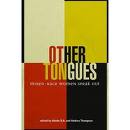
Other Tongues: Mixed Race Women Speak Out

I was very excited when this anthology arrived in the mail. Having visted the facebook page and read a call for submissions on Adebe DeRango-Adem’s blog, I had high expectations of what the editors would bring together in this book. It definitely held up to my own hype – it is a beatifully arranged mix of stories, personal histories, poetry and artwork that directly address the mixed race experience for women. It is broken into three sections: “Roles/Rules” (the ‘what are you’ questions, forming identity), “Roots/ Routes” (impact of location, intersections of ancestry and geography) and “Revelations” (wisdom gained from experiences). I found most of the pieces to be very well written and engaging. I highly recommend reading it! (Pick it up from the publisher or Amazon).

Here’s some of my favorite quotes from the book:

  • “I noticed that often white women and black women had different ways of asking. White women: is that natural or a perm? …Black women: which relaxer do you use?” – Liberty Hultberg, A Mixed Journey From the Outside In
  • “You study me. …Without colour, until you are told how to fill it in…Searching my face like it is a map of the world. Placing foreign features…Exoticizing.” Erin Kobayashi, Pop Quiz
  • “We’re huddled on the tiny island of bed, quiet/ in the language of blodd: the house, unsteady/ on its cinderblock haunches, sinking deeper/ into the muck of ancestry” -Natasha Tethewey, Southern Gothic
  • “…I really made a concerted effort to appear blacker. My daily concerns involved embodying the cultural representations of what blackness meant to me” -Kathryn McMillan, Whitewashed
  • “I am keenly aware that in queer spaces I am more often ‘of Colour’ and in White spaces I’m more often straight…I get spoken In, I get spoken Out, through microinvalidations and microinsults. …Sometimes I lie. Sometimes not correcting is the lying. Sometimes its not.” -Kimberly Dree Hudson, Racially Queer Femme
  • “Identity is not a measure of bllod quantum/ it is a nationhood, it is a language, it is a family/ it is in my blood, my blood memory” -Shandra Spears Bombay, The Land Knows

Also see all of Miranda Matini’s “The Drinking Gourd,” Marika Schwandt’s “Mulatto Nation,” and Rachel Afi Quinn’s “Combination of the Two.” As quoted above, Kimberly Dree Hudson’s “Racially Queer Femme” rocked my world with its brillance; and for adding the word intersectionality to my discourse of mixed race identity. Thank you to Adebe and Andrea Thompson for editing this awesome anthology and bringing these voices to light.
When Mixed Folks aren’t Speaking for Themselves…

…You get muddled articles like these two. John McWhorter of The Root wrote this article, “Why Are We Angry At Biracial People,” which attempts to support people who don’t exclusively classify as Black; however I finished the article not feeling triumphed, but alienated.  His conclusion just doesn’t get it right:

“There will be actual black people. There will also be those who are only part black, and there will be more of them by the decade. It’s high time that America, black and white, stopped telling them that there’s some kind of higher wisdom in adopting the racial-classification strategies of Strom Thurmond. Go on, “biracial” people. I call it “black to reality.”

But then, there’s a response like this one: Bene Viera’s article in Clutch magazine titled “Stop Bringing the Biracial Issue to the Doorsteps of Blacks.” (The title is enough to make you cringe, right?) She heavily critiques McWhorter’s article. I was happy to see that she made clear that mixed race identity is more complex than portrayed in the other article, however, I still feel that she treats, (as she calls it) “the biracial issue” with insensitivity. Don’t even read the comments – its not worth the energy.

NY Times: Young and Mixed in America

Check out this article about the mixed race movement in the New York Times. It highlights the efforts of mixed race youth in defining their identity and calling for a celebration of ethnic diversity. I think the ending quote from the student president of this college’s Multiracial and Biracial Student Association is very telling of the attitude of young mixed people today:

“I don’t want a color-blind society at all,” Ms. Wood said. “I just want both my races to be acknowledged.”

Also, check out the video.

The Rumpus Interviews Neela Vaswani

Read this interview with Neela Vaswani; mixed writer and activist who is coming out with a new book.

Quote from the interview:

Rumpus: You begin your memoir, “This place, that place. You have to stand someplace. I pledge allegiance to the in-between.” Being of Irish-American and Indian descent, you write that while growing up, you often felt a sense of division and separateness in your own skin, like there was a war in your body. Did writing this book help you reconcile the duality of “this place,” and “that place,” and embrace the gray “in-between?”

Vaswani: The point of the book is that when you’re a certain kind of person, you’re born embracing the in-between, because you are the in-between. And therefore it’s not a gray place at all. It’s a vivid place. It’s as real and contoured and legitimate as this place or that place. I think it’s society and the human tendency towards rigid categorization that gives the in-between a sense of division or incompleteness. I already knew this and lived it before writing the book. But in writing the book, I found a way to voice it to other people.

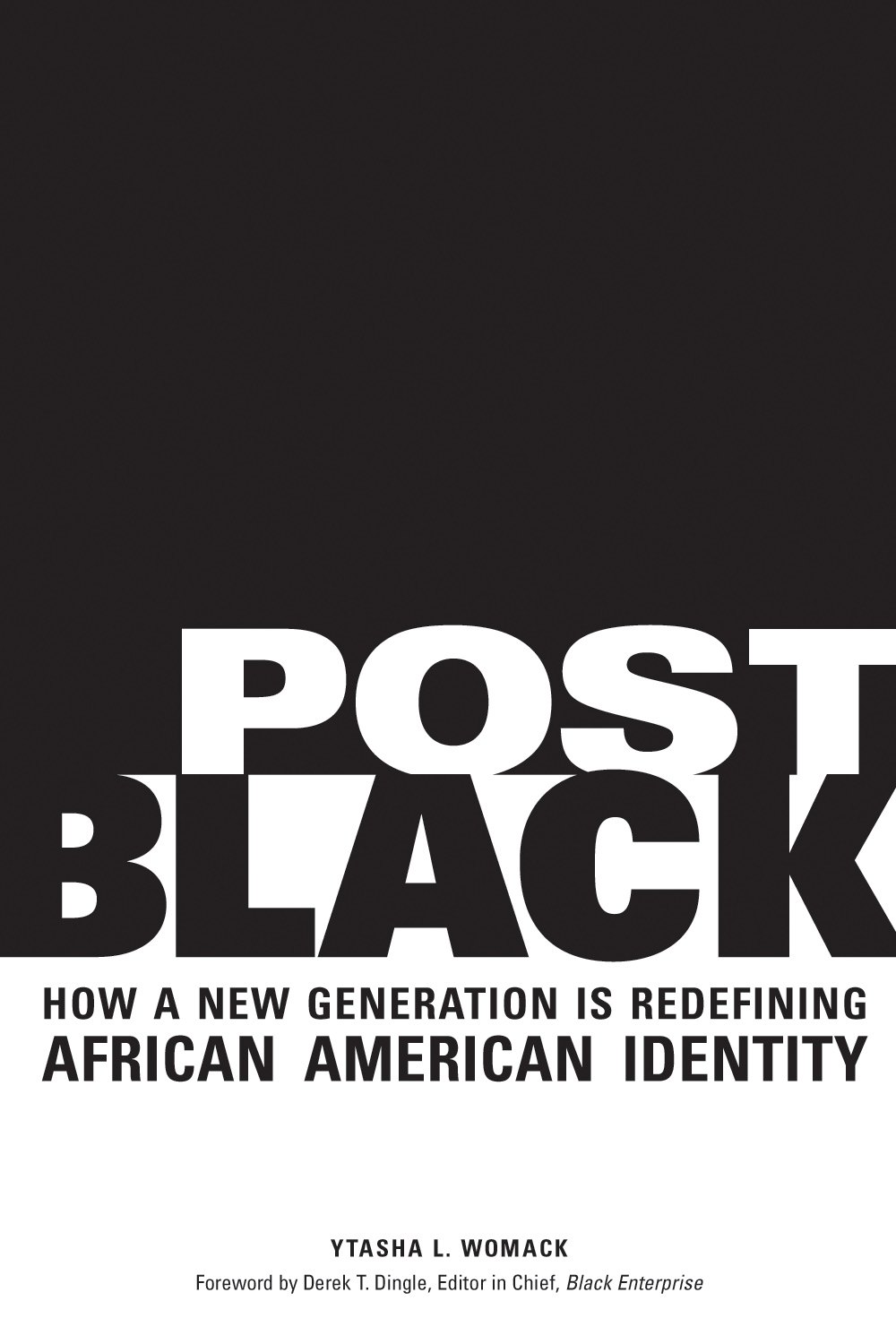
Read This: Ytasha Womack, Post Black

Womack takes a refreshing look on African-American identity in the terms of the Generation X and Y’ers who are creating new communities that defy old stereotypes. From personal experience, interviews and research, she examines young black entrepreneurs, biracial/multiethnic youth, GLBT black youth, artist communities, and feminism in today’s black culture. Womack’s writing is readable and engaging as she illuminates parts of black identity that have no voice in our mainstream culture.

  • Post Black is about emerging groups, both violent and forceful, whose voices and issues are entrenched in communities but are not a part of the social agenda, public discussion, national politics, or collective black identity” (23).

Read the introduction and first chapter here on Google Books.

And here is the blog Womack started for the book.

Rachel Harper, Brass Ankle Blues

Brass Ankle Blues is a coming of age story, following fifteen year old Nellie as she navigates a summer of self-discovery. She harbors anger towards her parents: her mother is in and out of her life, and neither give her the support she craves to figure out her mixed race identity. While looking for the familiar, (spending time with her family at their cabin at the lake), she is confronted with things that are new. Nellie develops a new relationship with her cousin Jess, falls for a neighbor, experiences the death of a grandmother, and other things that test her developing sense of self. Harper’s prose is delicate but direct, never giving in to lengthy, flowery descriptions; instead cutting deep to the heart of Nellie’s journey.

  • “When I was seven I told my father that I wanted to grow up to be invisible. He told me to read Invisible Man. For him, the answers were always in books. I did read Ellison’s novel, but I seem to have the opposite problem. …[People] follow me with their eyes, their questions. They ask me things I haven’t even asked myself” (Prologue)
  • “…my whole body has been covered with small brown moles…I think of them as the mark of miscegenation. I wonder if this flawed skin is the ultimate sign of weakness, evidence that my blood shouldn’t be mixing in my veins. …More come every year and by the time I die I will probably be covered. On my deathbed I will finally be a black woman” (18).
  • Jess: “Your family’s something else. You’re all these different mixed-up things -” Nellie: “So what does that make us?” Jess: “I don’t know. There’s no one word.” Nellie: “Exactly…and until we come up with one, we’re black” (58).

Check out the author’s website

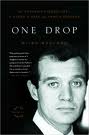
Bliss Broyard, One Drop

This book is daunting in size; around 500 pages of intertwined memoir, history, and research. That said, most of the time spent reading  is worth it. The first section of the book follows Broyard’s direct narrative in a traditional memoir style as she and her brother learn their family secret: that their father, Anatole Broyard, had African American ancestry.

Reflection on her father keeping this part of himself secret: “Did he ever contemplate telling me? Was he looking at me and considering just how black I seemed? Was he thanking his lucky stars once again that my hair was not curly, not kinky, that my skin was olive, not dusky, that my lips were thin, my nose only slightly wide, and that my ass was small? Did he worry that someday one of us might be found out?” (73).

The middle section of the book delves deep into the Broyard family history, as she traces her father’s family to the 1700s. The third section follows the same timeline structure focusing on her father’s upbringing, him meeting her mother, and slides right back into Bliss Broyard’s point of view. This is an important piece of work, and I find it incredible that Broyard could bring together that much family history.

This video is an introduction to the premise of the book:

Here’s an interview she did about the book (though the reporter guy is a bit annoying):