
Month: February 2011
Article Links
New York Times article: “Counting By Race Can Throw Off Some Numbers”
San Francisco Chronicle: “Mixing It Up: Multiracialism redefines Asian American Identity”
Happy Reading!
Other Tongues: Mixed Race Women Speak Out
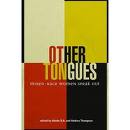 I was very excited when this anthology arrived in the mail. Having visted the facebook page and read a call for submissions on Adebe DeRango-Adem’s blog, I had high expectations of what the editors would bring together in this book. It definitely held up to my own hype – it is a beatifully arranged mix of stories, personal histories, poetry and artwork that directly address the mixed race experience for women. It is broken into three sections: “Roles/Rules” (the ‘what are you’ questions, forming identity), “Roots/ Routes” (impact of location, intersections of ancestry and geography) and “Revelations” (wisdom gained from experiences). I found most of the pieces to be very well written and engaging. I highly recommend reading it! (Pick it up from the publisher or Amazon).
Here’s some of my favorite quotes from the book:
- “I noticed that often white women and black women had different ways of asking. White women: is that natural or a perm? …Black women: which relaxer do you use?” – Liberty Hultberg, A Mixed Journey From the Outside In
- “You study me. …Without colour, until you are told how to fill it in…Searching my face like it is a map of the world. Placing foreign features…Exoticizing.” Erin Kobayashi, Pop Quiz
- “We’re huddled on the tiny island of bed, quiet/ in the language of blodd: the house, unsteady/ on its cinderblock haunches, sinking deeper/ into the muck of ancestry” -Natasha Tethewey, Southern Gothic
- “…I really made a concerted effort to appear blacker. My daily concerns involved embodying the cultural representations of what blackness meant to me” -Kathryn McMillan, Whitewashed
- “I am keenly aware that in queer spaces I am more often ‘of Colour’ and in White spaces I’m more often straight…I get spoken In, I get spoken Out, through microinvalidations and microinsults. …Sometimes I lie. Sometimes not correcting is the lying. Sometimes its not.” -Kimberly Dree Hudson, Racially Queer Femme
- “Identity is not a measure of bllod quantum/ it is a nationhood, it is a language, it is a family/ it is in my blood, my blood memory” -Shandra Spears Bombay, The Land Knows
Also see all of Miranda Matini’s “The Drinking Gourd,” Marika Schwandt’s “Mulatto Nation,” and Rachel Afi Quinn’s “Combination of the Two.” As quoted above, Kimberly Dree Hudson’s “Racially Queer Femme” rocked my world with its brillance; and for adding the word intersectionality to my discourse of mixed race identity. Thank you to Adebe and Andrea Thompson for editing this awesome anthology and bringing these voices to light.
When Mixed Folks aren’t Speaking for Themselves…
…You get muddled articles like these two. John McWhorter of The Root wrote this article, “Why Are We Angry At Biracial People,” which attempts to support people who don’t exclusively classify as Black; however I finished the article not feeling triumphed, but alienated. His conclusion just doesn’t get it right:
“There will be actual black people. There will also be those who are only part black, and there will be more of them by the decade. It’s high time that America, black and white, stopped telling them that there’s some kind of higher wisdom in adopting the racial-classification strategies of Strom Thurmond. Go on, “biracial” people. I call it “black to reality.”
But then, there’s a response like this one: Bene Viera’s article in Clutch magazine titled “Stop Bringing the Biracial Issue to the Doorsteps of Blacks.” (The title is enough to make you cringe, right?) She heavily critiques McWhorter’s article. I was happy to see that she made clear that mixed race identity is more complex than portrayed in the other article, however, I still feel that she treats, (as she calls it) “the biracial issue” with insensitivity. Don’t even read the comments – its not worth the energy.
 Mixed Reader